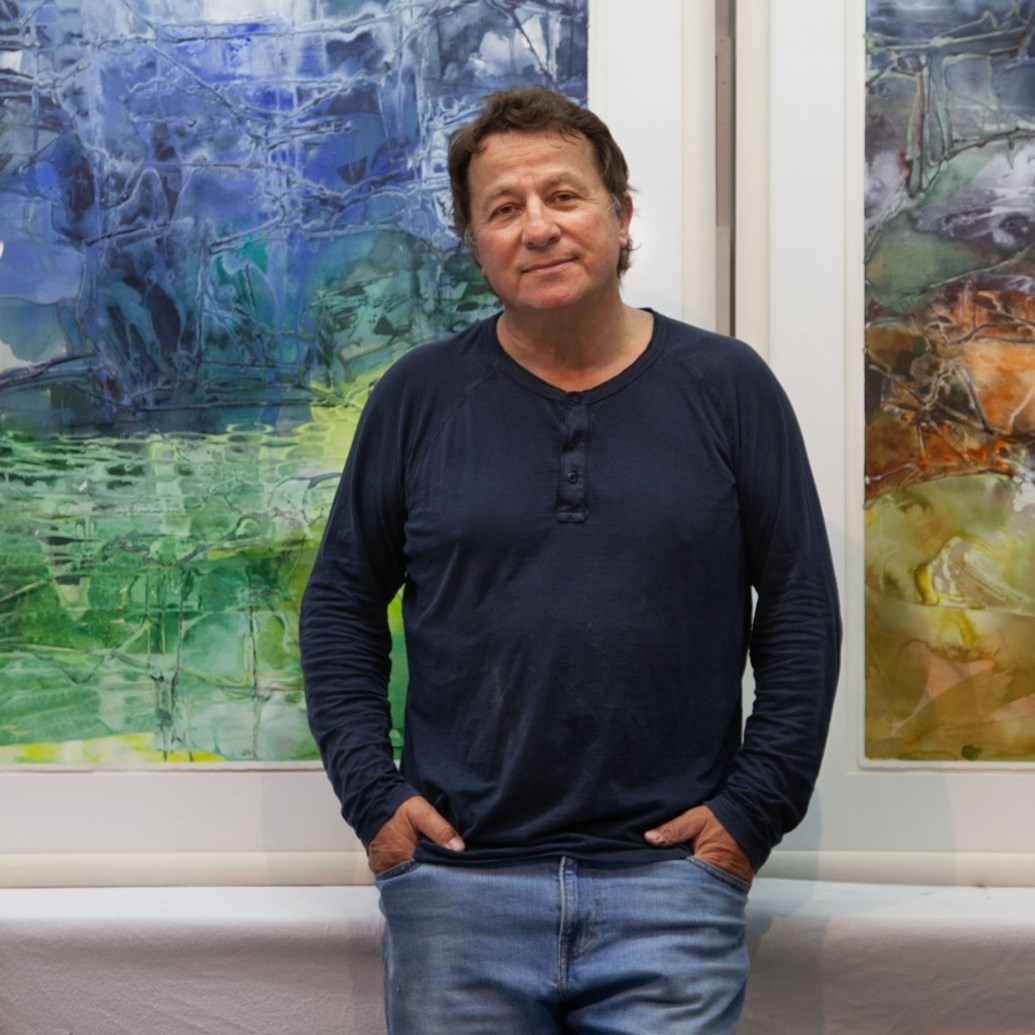
Biography
Overhead Shots – Structures and Sounds
For me, the view from above through a camera lens mounted on a drone or a helicopter, of a primeval landscape not reshaped by man and with the horizon removed, becomes a phenomenon in its own right.
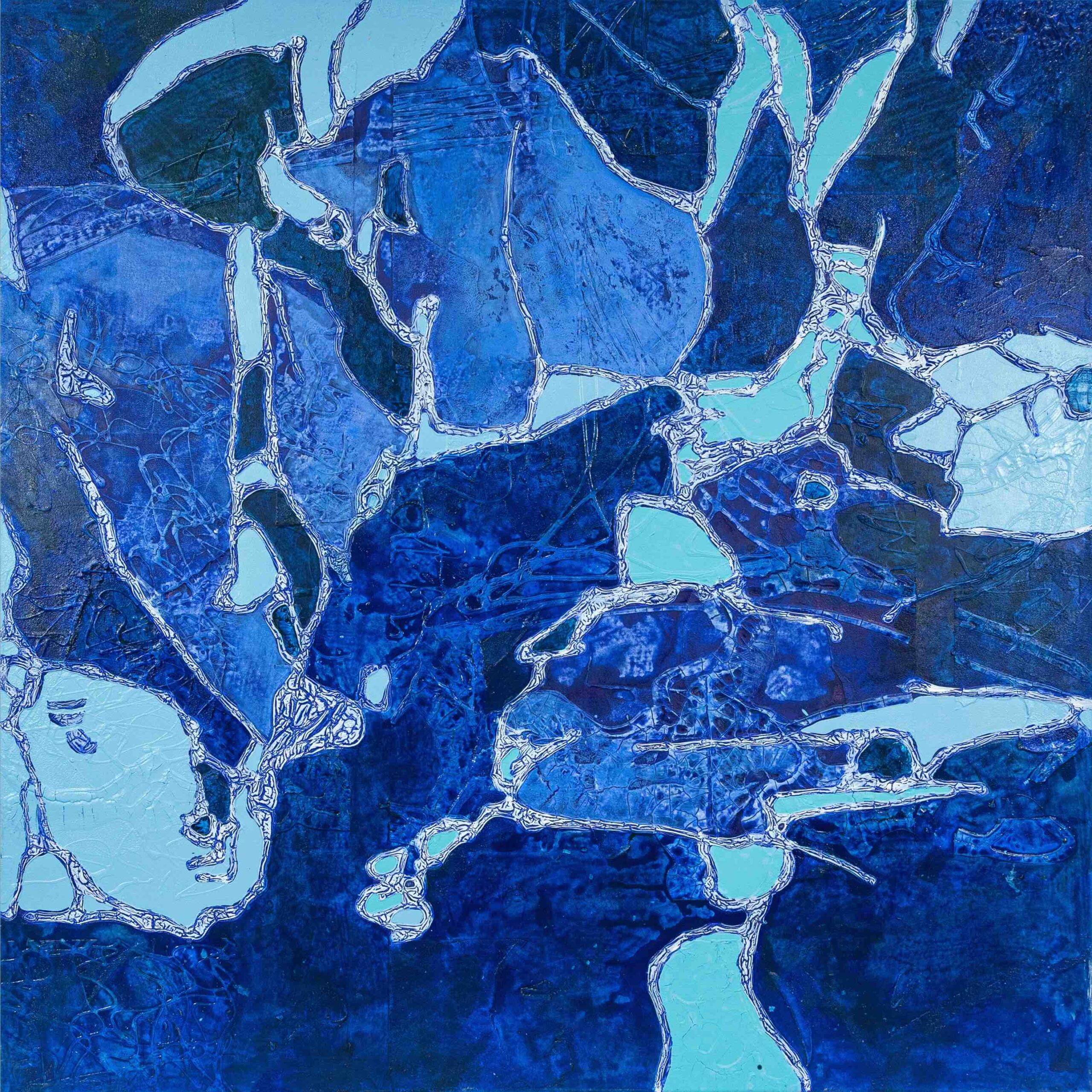
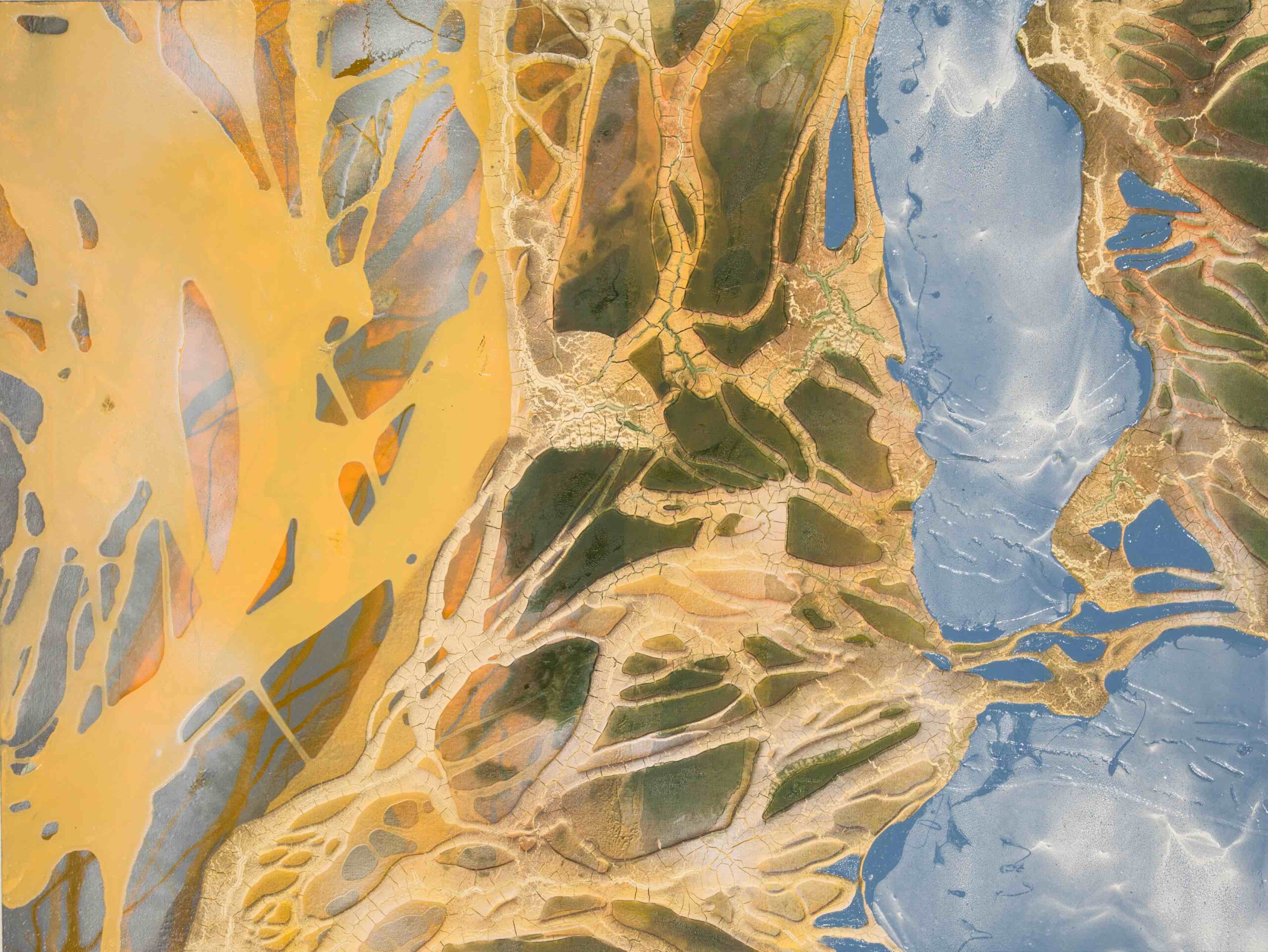
Pictures and views, often with a high degree of abstraction and an almost painterly quality, emerge and are not unlike the impressions obtained by looking through a microscope.
On closer inspection, I discover many parallels between this type of landscape and more complex music.
Structures, rhythms, colours, spaces and the interaction between them, the contoured and the unfocused, harmonies within deep layers of sound, irritated or enriched by dissonance, push forward or retreat thoughtfully, only to merge into a greater whole.
Inspired by such landscapes and by memories of what has been seen, a series of paintings emerges in the studio which—at first playfully—seeks to create corresponding images of these phenomena.
Thus it appears that, initially unconsciously and without any concrete intention, associations between landscape and music arise in the process of creation, while the boundaries between the respective genres remain fluid.
The Natural and the Artificial
In Iceland, what I saw photographically through the lens of my drone marked the beginning of a pictorial interpretation of the confluence of nature and technology: a series of power stations embedded in archaic landscapes, artificial forms set against the organically grown structures of an untouched environment.
Later, and quite coincidentally, I came across a satellite image of the “Burning Man Festival” in Nevada, at the edge of the Black Rock Desert. Its semicircular structures and enclosures, resembling a hexagram, formed a striking counterpart to the surrounding desert landscape.
It was an image whose chromatic appeal held a fascination similar to that of the scenes observed in Iceland. Here, too, the tension, relationship and interaction between the organic and the inorganic, the natural and the artificial, became evident.
In its counterpoint, polarity and mutual interdependence, I recognised a surprising analogy to my own patterns of thought and character. The sensual, almost excessive quality I seek in painting contrasts with a precision that can at times verge on the pedantic—both aspects inherent in my nature and reflected in the structured processes of technical forms.
Where human intervention enters the natural world, it does not result solely in destruction—though that is certainly one aspect—but can, under favourable conditions, open up a perspective aligned with a more phenomenological and aesthetic mode of perception.
Drone Photography
In recent years, the drone has increasingly become the basis of my photographic observations, enabling entirely new and less familiar views of landscapes from a bird’s-eye perspective.
The golden ratio—and with it the horizon of conventional landscape representation—suddenly ceases to play a role. Landscape appears almost two-dimensional, giving rise to unfamiliar painterly arrangements of colour and form within a markedly reduced sense of spatial depth.
Connections between the macrocosm and the microcosm begin to emerge. In this way, the view through a microscope becomes comparable to the aerial perspective of a drone observing a landscape from above.
Translated into painting, this unconventional perspective allows for a significantly freer, more playful, more abstract and painterly understanding of landscape-related imagery, while largely detaching it from clear, object-based associations within the image.